This is Cinema

Denis Villeneuve has truly cracked the code for bringing what was long considered an unadaptable sci-fi franchise to the big screen, with little to no flaws. Dune: Part Two directly follows Dune: Part One (2021), building upon the world established in the first film and effectively condensing years of story into the span of months within a single movie. There are no words to describe my viewing experience other than to call it the epitome of science fiction cinema.
Part Two instantly throws us back into the narrative where the first movie left off. Since I last saw Part One in theaters, my memory of the events was a bit hazy. Fortunately, the film manages to keep the audience up to speed without overwhelming them with excessive backstory or oversimplifying the plot. Having read the first book before, various scenes in the movie sparked recollections of the novel, effortlessly pulling me back into the story. Much like my experience with Part One, Villeneuve brought the world of Dune to life in a manner even more spectacular than I had imagined.
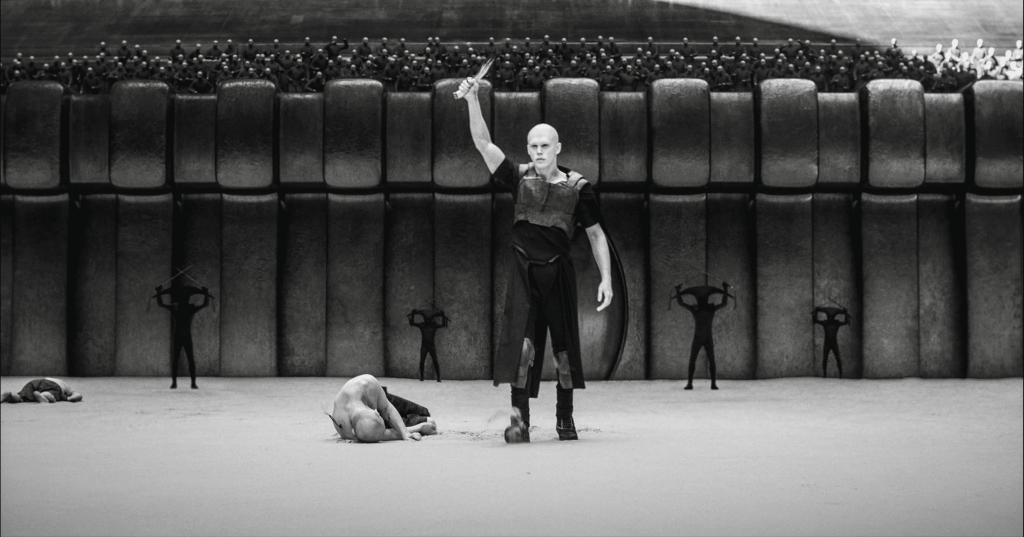
It is this realism that makes Part Two work so well for me. For instance, there is a sequence featuring a fight scene on Giedi Prime, homeworld to House Harkonnen. From the eerie depiction of the hairless, white-skinned Harkonnens—which Austin Butler’s Feyd-Rautha perfectly captures—to the black and white infrared palette used to color the surroundings (as Giedi Prime orbits a black sun), everything felt incredibly real. It showcased the extraordinary lengths to which the filmmakers went to perfect every last detail.
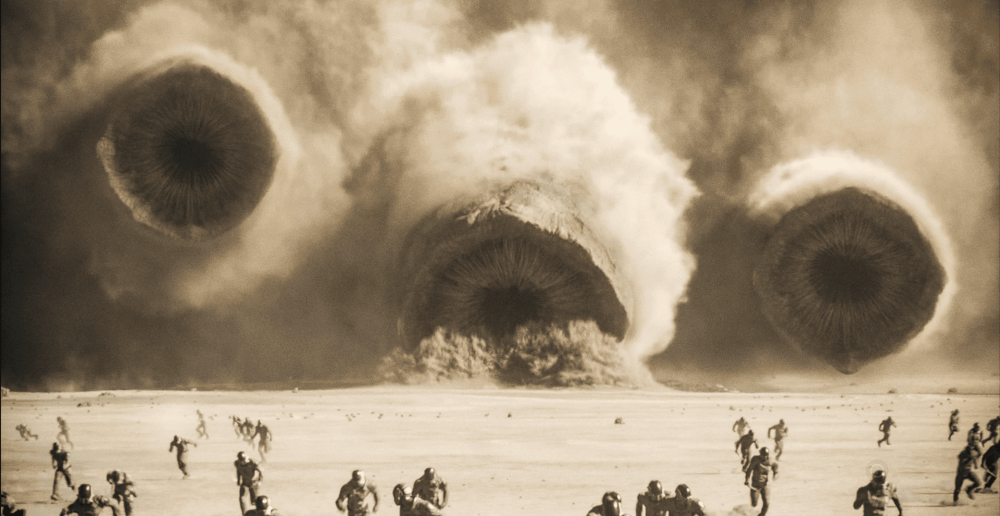
This was also the case for the CGI, which was indistinguishable from the real set. Everything from the ship exteriors to the worms’ teeth was hyper-realistic. I was fully immersed, and the cinematography only added to this level of immersion, so much so that I couldn’t single it out to marvel at it because I was so engrossed with what was happening on screen—It felt as if I was in the movie. Even after praising all of this, it was the fight scenes where I found myself completely locked in. They were so intense that the entire theater became pin-drop silent.
Hans Zimmer’s score further deepened this immersion; it felt like a part of the story rather than an addition to it. The Middle Eastern, Islamic, Lawrence of Arabia-esque influences that made up the music not only elevated the film’s grandeur but also introduced an entirely new sound to the science fiction genre.
However, I wouldn’t be surprised to hear criticisms regarding the lack of immersion due to the prolonged shots and the sometimes-slow pace of certain sequences—aspects that were widely unpopular for with the general audience of the first film. This movie clearly isn’t aimed for the chronically online with near brain-rot attention spans, and instead reminds me of the lingering shots in Stanley Kubrick’s 2001: A Space Odyssey. For a narrative as vast and intricate as Dune, such pacing choices enhance the storytelling. There’s no scenario in which I see Dune working as a fast-paced spectacle—we’ve seen how that worked out in David Lynch’s version, which pales in comparison to the current adaptation.
One aspect that did sit well with many in Part One was the star-studded cast’s portrayal of their characters, and the characterization is as strong in Part Two. Beyond Austin Butler’s performance, I was particularly impressed by Timothée Chalamet’s portrayal of the increasingly nuanced Paul Atreides, as well as Javier Bardem’s Stilgar, who’s acting not only convinced me of the deep influence that religious fanaticism can hold, but also introduced some comic relief that tempered the movie’s overall seriousness. Zendaya’s portrayal of Chani and Rebecca Ferguson’s role as Lady Jessica were equally convincing, though I was a little disappointed by the limited screen time of other cast members like Christopher Walken and Florence Pugh. I wouldn’t have minded if the movie exceeded the 3-hour mark to further develop characters and their story arcs or to include more cinematic shots—the film didn’t even feel like it was 2 hours and 40 minutes long!
Overall, Dune: Part Two stands as a stunning cinematic triumph, placing a deep emphasis on storytelling to weave a compelling narrative. Just as Star Wars revolutionized the landscape in the 1970s, Dune has elevated the standards—ushering in a new era and a paradigm shift for the science fiction genre.