
A Blueprint for the Modern Blockbuster

While not entirely groundbreaking in its core concept (dystopian societies and forced combat have been explored before), The Hunger Games undeniably revitalized the Battle Royale genre for a new generation. Its success wasn’t just a lucky strike; it is a testament to its strengths as a well-crafted blockbuster and a faithful adaptation.
The Hunger Games doesn’t shy away from the brutal realities of its premise. Despite its PG-13 rating, the film doesn’t gloss over or sugarcoat anything for the audience. The violence, though not overly graphic, is impactful and unflinching. This commitment to maturity allows the film to resonate with a wider audience that might normally avoid teen-oriented movies. It’s a bold choice that pays off, proving that a young adult film can tackle complex themes and appeal to viewers of all ages.
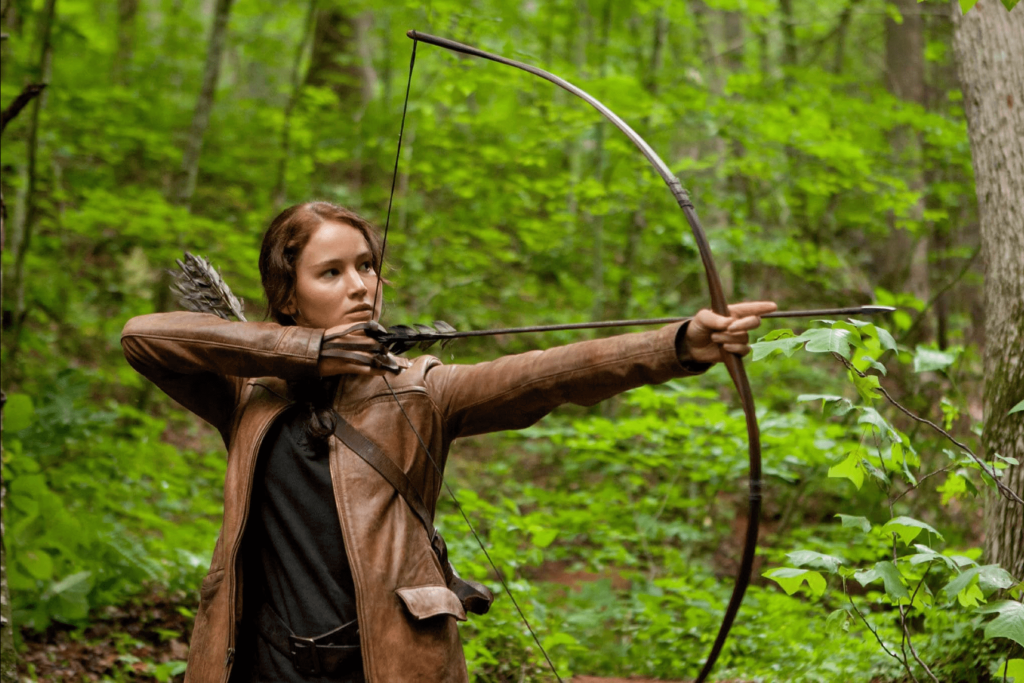
Furthermore, the casting is phenomenal. Jennifer Lawrence embodies Katniss Everdeen with remarkable depth that goes beyond the pages of the source material. Her performance captures Katniss’s resilience, vulnerability, and fierce determination that define the iconic character. Stanley Tucci brings charisma and a magnetic presence to the flamboyant Gamemaker, and Donald Sutherland, despite limited screentime, is as intimidating as ever as President Snow.
The Hunger Games’ cinematography presents a mixed bag: It maintains a solid foundation by prioritizing practical effects over an overreliance on CGI, contributing to an enhanced sense of realism. Yet, scenes such as the Tribute Parade featured special effects, notably the fire, that appeared noticeably artificial, reducing immersion and serving as a slight detraction from the overall visual authenticity of the film. Additionally, while the frenetic editing and shaky cam, reminiscent of Greengrass’ Jason Bourne Trilogy, effectively convey the chaos of the Games, their overuse in action sequences becomes distracting and disorienting. The constant blurring and jerky movements are visually impeding, particularly during the beginning of the Hunger Games, where character movements get lost in the shaky frame. This stylistic choice diminishes the impact of the action scenes.
Though the film excels at pacing and engagement, it stumbles emotionally. There were several scenes, upon retrospect, that did not meaningfully contribute to the narrative, such as the control room scenes. Sure, they showcased the inner workings of the game, but more time should have been repurposed to explore and develop the characters within the story. For instance, Peeta’s character was presented very surface level (Josh Hutcherson delivers a charming performance, but the script shortchanges his emotional depth). To add to this, the forced romance between Peeta and Katniss lacks the nuanced build-up of the book. And Rue’s death, primarily seen through Katniss’s eyes, loses some of its raw emotional power. Had the film delved deeper into these characters’ emotions, the story’s emotional core could have resonated even stronger.
Despite these shortcomings, The Hunger Games remains a captivating and successful film. It delivers on its promises, offering a solid storyline and a satisfying conclusion, largely thanks to its faithfulness to the source material. Although nothing revolutionary, The Hunger Games serves as a strong start to the franchise, demonstrating the effectiveness of faithful book-to-screen adaptations—a lesson Hollywood continues to grapple with, whether intentional or not.